
What the Digital News Report 2026 tells publishers about platformization, fragmented audience journeys, and the value of controlling the content underneath them. For more than a decade, publishers have adapted to one distribution shift after another: from print to web, desktop to mobile, direct visits to search and social.
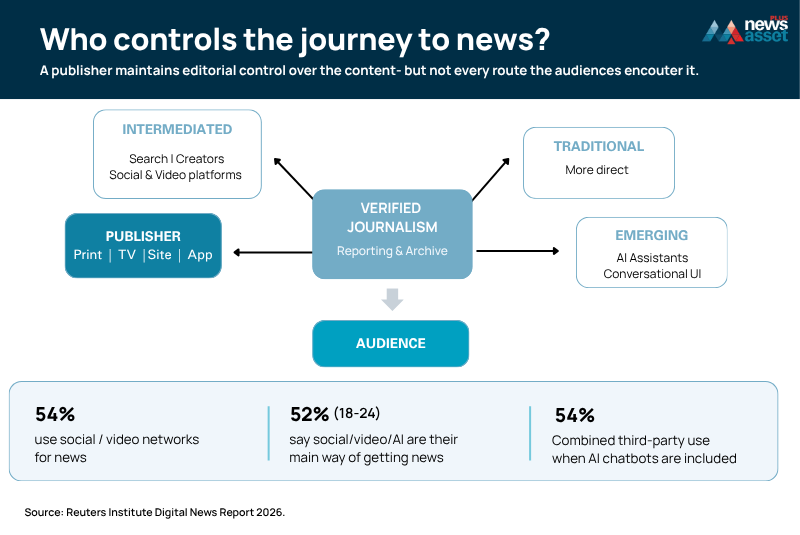
But the Reuters Institute Digital News Report 2026 points to something more fundamental. For the first time globally, social media and video networks are the most widely used source of news, reaching 54% of respondents, compared with 52% for TV and 51% for news organisations’ own websites and apps. When AI chatbots are included, combined third-party news use reaches 56%.
The margins are small, and the Reuters Institute itself cautions against over-interpreting the two-point gap between social/video and TV. The direction of travel, however, is much clearer. Social and video networks now outperform publishers’ own websites and apps in 30 of the 48 markets covered by the report, while both TV and online properties have declined substantially over recent years. The bigger story, then, is not simply that audiences have moved to another channel.
Publishers may still own journalism. Increasingly, they do not own the entire journey through which audiences encounter it.
From destination to intermediated discovery
The traditional digital publishing model was built around destinations. A publisher produced a story and audiences eventually arrived somewhere the publisher controlled: the homepage, an article, an app, perhaps a newsletter.
Those destinations remain important. Direct access is still comparatively strong across parts of Europe and several affluent Asian markets, and established news brands continue to play a significant role in audiences’ news diets.
But an increasing share of news consumption now takes place inside environments designed and controlled by somebody else.
Search engines decide which links surface. Social platforms determine what appears in the feed. Video networks shape discovery through recommendation algorithms. Creators increasingly add their own interpretation and presentation. And AI interfaces are beginning to introduce yet another layer between journalism and its audience.
The Reuters Institute describes this as the growing phantomization of news consumption. Even highly digitally advanced news organizations increasingly operate in markets where intermediated third-party platforms are more popular than the branded digital properties publishers themselves have spent years building.
That has implications beyond referral traffic. When a story is encountered through a social feed, video platform or creator account, the publisher has less control over the surrounding context, presentation and route the audience takes next.
Distribution is therefore becoming more than the final step after publication. It is increasingly part of the news experience itself.
This is not simply a Gen Z story
The shift is most visible among younger audiences. Globally, 52% of 18–24-year-olds now say social media, video networks and AI chatbots are their main way of getting news. For this group, that is 32 percentage points ahead of the next most popular source. But reducing the issue to Gen Z risks missing the larger structural change.
The Reuters Institute finds that the changing composition of news consumption is happening across age groups. News websites and apps are no longer the leading main news source for any single age group globally, while those under 35 show a particularly different relationship with traditional and platform-based sources. There is also little evidence that publishers can simply wait for younger audiences to grow into yesterday’s habits. Among 18–24-year-olds who did not read a newspaper in the previous week, 56% say they have never regularly read one.
Something to think about
For publishers, the more useful question is therefore not “how do we persuade every audience to consume news in the same way?” .
It is “how should journalism work when different audiences encounter the same reporting through very different environments?“
Platforms are changing the form of news, not just its distribution
Online video makes this shift particularly visible. The DNR finds that 77% of respondents globally now consume online news video every week, with a majority doing so in every market covered by the report. But the growth is overwhelmingly happening on third-party platforms rather than on publishers’ own digital properties. Video consumption on publisher websites and apps fell by five percentage points in the latest year and by ten points compared with 2021. This distinction matters.
News publishers may themselves be producing some of the journalism being watched on YouTube, Instagram or TikTok. The Reuters data cannot tell us what proportion of third-party video consumption belongs to established media. But it does show that the environment in which journalism is consumed is moving away from publishers’ owned properties.
Creators add another dimension. Twenty-seven per cent of the global sample now gets some news each week from news-focused creators. Most are not replacing traditional media: only 3% say they rely solely on creators for news. Instead, creators generally supplement existing news habits.
What audiences value about them is instructive. Creators tend to be seen as more entertaining, easier to understand and more relatable, while the general public tends to judge them less positively on trustworthiness and impartiality.
The implication is not that publishers should turn every reporter into an influencer. It is that format, tone and accessibility increasingly form part of the competitive environment in which journalism operates.
A strong piece of reporting may need to support a full article, an explainer, a newsletter item, a social output or another channel-appropriate presentation — while the facts, provenance and editorial standards underneath it remain consistent.
The platform paradox
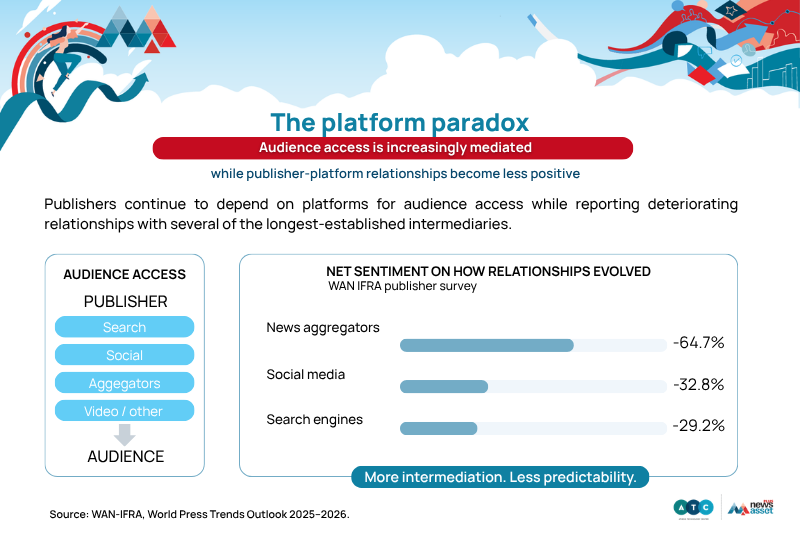
There is another reason this shift matters strategically. Publishers increasingly rely on intermediaries to reach audiences at precisely the moment when many of those business relationships are becoming more strained.
The WAN-IFRA World Press Trends Outlook 2025–2026, based on responses from 172 senior media executives and newsroom leaders across 66 countries, paints a striking picture. Publisher sentiment about evolving relationships with news aggregators reached –64.7%, by far the most negative result among the platform categories surveyed. Search engines recorded net sentiment of –29.2% and social media platforms –32.8%. WAN-IFRA links the particularly sharp deterioration in aggregator relationships to issues including traffic declines, algorithmic changes and revenue partnership models.
This creates a structural tension: publishers need intermediaries for discovery and reach, while having limited influence over the algorithms, commercial incentives and user experiences those intermediaries control. This does not make platforms the enemy. They remain essential audience channels and, depending on the market and platform, important sources of growth. But it makes dependency itself a strategic issue.
AI adds a different kind of intermediary
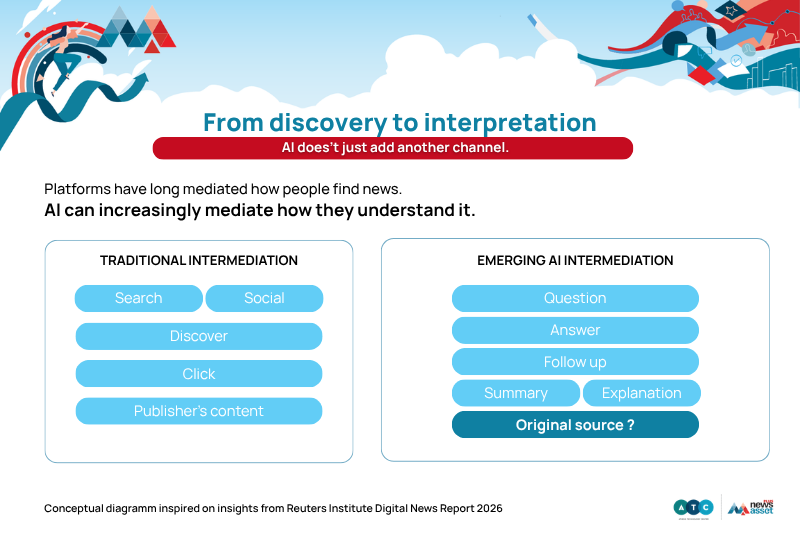
AI chatbots remain a much smaller news source than social media or video platforms. Weekly use for news increased from 7% to 10% globally in 2026, and the Reuters Institute describes that growth as meaningful but not yet explosive. Yet, AI introduces a potentially different form of intermediation. Search engines and social platforms have traditionally helped audiences find journalism. Conversational AI can increasingly help audiences interpret it.
An AI interface can provide a summary, combine information from different sources, answer follow-up questions or explain a complex issue before the user ever reaches the original article. That distinction matters.
That is the subject of the next article in this series.
What can publishers still control?
Publishers cannot control every algorithm, referral mechanism or new AI interface. Nor is the realistic answer to recreate every external platform inside the publisher’s own environment. But there is a layer they can strengthen: the journalism underneath the distribution system.
That means moving beyond a model where content is primarily treated as a finished page for a specific channel. Instead, publishers can increasingly think of journalism as an editorial asset that remains identifiable, structured and adaptable throughout its lifecycle.
That has three practical implications.
First, journalism needs to be able to travel. A verified story should be easier to retrieve, adapt and reuse across different outputs rather than repeatedly rebuilt from scratch.
Second, adaptation should not mean losing the editorial layer. Provenance, context, editorial standards and human control become more important as content moves across different environments.
Third, assets that publishers control directly become increasingly valuable. Structured archives, rich metadata and publisher-controlled audience experiences provide a stronger foundation as external discovery becomes more fragmented.
This is also where editorial infrastructure becomes strategically relevant.
The newsasset PLUS approach is built around this principle: treating journalism as structured and reusable content rather than as a collection of isolated final outputs. Its current capabilities include Digital Asset Management, metadata enrichment, automated tagging, IPTC classification, archive management, controlled content adaptation and cross-channel publishing.
The opportunity is not simply more content
The DNR’s wider findings make this especially important. Interest in news has declined significantly in many markets, while trust has fallen to its lowest recorded global level since the Reuters Institute began tracking it. At the same time, audiences continue to value journalism in both established and emerging formats.
The challenge is therefore unlikely to be solved by simply putting more stories into an already saturated information environment. As the Reuters Institute argues, the more constructive opportunity is to focus on how journalism can help people interpret what is happening and understand its relevance to their lives.
Something to think about
For publishers, that changes the strategic question. It is no longer simply “how can we publish more, across more channels?”
It is increasingly “how can the journalism we already produce remain useful, recognisable and adaptable wherever audiences encounter it?“
Publishers may no longer own every step of the journey to the news. But they can strengthen their control over the journalism that travels through it.
Note: This post’s header image is an AI-generated artistic representation used for conceptual purposes only.