
Beyond the recognition: What manufacturers should know about AI-enabled ERP, operational capabilities and choosing the right technology partner.
Manufacturing ERP is entering a new phase
Manufacturing ERP systems have traditionally been evaluated on their ability to support essential operations: production planning, material requirements, inventory management, procurement, quality and financial control.
These capabilities remain fundamental. But as artificial intelligence becomes more deeply integrated into enterprise software, manufacturers are also asking how their ERP systems can help them access information faster, support better decisions and automate increasingly complex workflows.
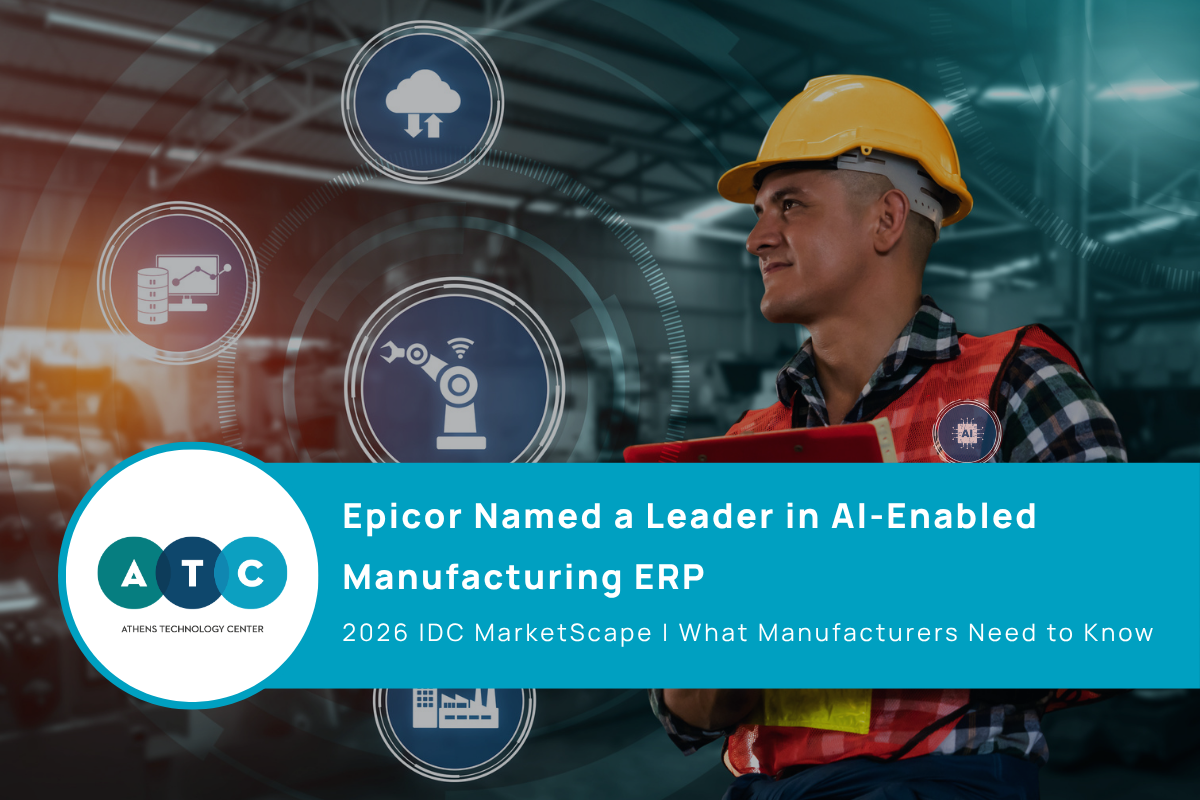
This evolution is reflected in the IDC MarketScape: Worldwide AI-Enabled Manufacturing ERP 2026 Vendor Assessment, published in October 2026.
The assessment examines 16 ERP vendors based on their current capabilities and future strategies for AI-enabled manufacturing.
Epicor was positioned in the Leaders Category,
reinforcing its position among the vendors recognized in this evolving market.
For manufacturers considering ERP modernization, the significance extends beyond the recognition itself. The report offers a useful framework for understanding what matters when evaluating manufacturing-focused ERP platforms in the age of AI.
What does being a Leader in the IDC MarketScape mean?
The IDC MarketScape is a vendor assessment framework that evaluates technology providers across two dimensions: capabilities and strategies.
Capabilities reflect how effectively vendors address customer requirements through their current products, services and execution.
Strategies examine how well their future direction aligns with expected market needs.
In the 2026 assessment, IDC considers manufacturing-specific requirements alongside the growing importance of AI capabilities, industry expertise and partner ecosystems.
The distinction between current functionality and future strategy is particularly relevant.
Manufacturers may encounter AI features that are commercially available, capabilities demonstrated in selected environments and functionality that remains on a product roadmap.
These are not equivalent when making an investment decision.
The IDC MarketScape provides an additional source of information for assessing vendors, but it does not replace detailed requirements analysis, product demonstrations or customer reference checks.
Three strengths highlighted in Epicor’s assessment
1. Inventory management and optimization
Inventory management is one of the notable strengths identified in IDC’s assessment of Epicor.
The report highlights capabilities supporting inventory optimization, including the use of operational information to improve stock-level decisions.
For manufacturing companies, effective inventory management has implications far beyond the warehouse.
Excess inventory ties up working capital, while shortages of critical materials can disrupt production schedules, increase expediting costs and affect delivery commitments.
Consider a manufacturer that receives an unexpected order while a key component is already in short supply.
The ability to assess available inventory, outstanding purchase orders, material requirements and production priorities is essential to deciding whether the order can be fulfilled without disrupting existing commitments.
Manufacturing ERP systems can help connect these processes, supporting more informed purchasing, replenishment and production planning decisions.
This makes inventory optimization a practical example of why strong operational capabilities remain essential, even as ERP platforms become more AI-enabled.
2. Embedded AI and Epicor’s Cognitive ERP strategy
IDC also highlights Epicor’s direction toward Cognitive ERP: the integration of AI capabilities with industry-specific data, business logic and operational workflows.
The assessment discusses technologies such as Epicor Prism, Epicor Lux and Agent Foundry as elements of Epicor’s broader AI strategy.
These technologies illustrate a shift from ERP systems primarily used to record transactions and generate reports toward systems that can also support natural-language interaction, contextual insights and increasingly automated workflows.
For example, AI-enabled capabilities may help users retrieve information more intuitively, identify anomalies or receive recommendations within existing business processes.
The potential is significant, particularly where employees need to interpret large volumes of operational information.
However, the value of these capabilities depends on their maturity, availability, configuration and connection to reliable enterprise data.
Manufacturers should evaluate what is available and supported in their specific ERP environment, rather than assuming that every capability described in a vendor’s AI strategy is included in every deployment.
3. Manufacturing specialization and partner expertise
Epicor’s industry focus and partner ecosystem are also highlighted in the IDC assessment. Manufacturing ERP requirements differ substantially from those of general-purpose business software.
A make-to-order manufacturer, for example, must coordinate customer-specific requirements, material availability and production capacity. An engineer-to-order business may also need to manage complex bills of materials, engineering changes and project-related production activities.
Epicor Kinetic is designed to support manufacturing environments, bringing together capabilities for production management, material requirements planning, scheduling, purchasing, inventory and other core operations.
At the same time, implementing manufacturing ERP involves more than configuring software.
Businesses must align processes, migrate and validate data, integrate existing systems, train employees and establish reliable operational workflows.
This is where implementation expertise and an understanding of manufacturing operations become particularly important.
Five questions manufacturers should ask when evaluating AI-enabled ERP
Beyond vendor positioning, the IDC MarketScape offers a useful opportunity to reconsider how manufacturing ERP solutions should be evaluated.
Five questions deserve particular attention.
1. Does the ERP support our actual manufacturing model?
A system should be evaluated against the organization’s production environment, not simply its general feature list.
Manufacturers should examine how the platform supports their production methods, bill-of-material complexity, planning requirements, engineering changes and operational constraints.
2. How effectively does it connect planning and execution?
Reliable production decisions require consistent information across purchasing, inventory, production planning and shop floor operations.
If production progress is tracked separately from the ERP, or if planners rely on manually updated spreadsheets, the organization may struggle to respond quickly to disruptions.
Manufacturers should therefore assess how the ERP connects these activities and what additional systems or integrations may be required.
3. Are AI capabilities proven and relevant to our needs?
The presence of AI functionality is not, by itself, evidence of operational value.
Buyers should ask whether a capability is commercially available, how it is implemented, whether it has been deployed in comparable environments and what results can be demonstrated.
A clearly defined use case is more valuable than a broad promise of intelligent automation.
4. What is included in the solution, and what requires additional components?
Some manufacturing capabilities may be provided natively, while others depend on additional modules, partner applications or integrations.
This distinction affects licensing, implementation complexity, support responsibilities and the long-term cost of ownership.
The same scrutiny should apply to AI functionality.
5. Can the organization adopt and maintain the solution successfully?
An ERP system must work for the people who depend on it every day.
Production planners need reliable information. Shop floor personnel need practical workflows. Managers need visibility into performance and exceptions.
Training, change management, governance and local support all contribute to successful adoption.
For manufacturers, these considerations can be just as important as the underlying technology.
Why independent recognition should be part of — not the entire — ERP decision
Being positioned as a Leader in an analyst assessment is a meaningful recognition of a vendor’s capabilities and strategy. However, no analyst evaluation can determine the best ERP solution for every manufacturing company.
Organizations differ in production complexity, integration requirements, deployment preferences, budgets and operational priorities. The IDC assessment itself identifies areas where buyers should seek additional validation, including selected warehouse management requirements, process manufacturing capabilities and aspects of customer experience.
This reinforces an important principle:
vendor recognition should inform ERP selection, not substitute for it.
A structured evaluation should include realistic business scenarios, demonstrations of critical workflows, a clear understanding of the implementation scope and evidence relevant to the manufacturer’s operating model.
What this means for manufacturers in Greece and Cyprus
For manufacturing businesses in Greece and Cyprus, Epicor’s recognition provides an additional reference point when considering ERP modernization.
Many industrial organizations need to coordinate complex production processes while maintaining control over materials, capacity, costs and delivery commitments.
Epicor Kinetic provides manufacturing-focused ERP capabilities that can help organisations bring these processes into a more connected operational environment.
Our role is to connect the platform’s capabilities with each organization’s operational requirements — from production planning and inventory management to cross-departmental information flows and process improvement.
As AI-enabled ERP continues to evolve, this combination of manufacturing technology and implementation expertise becomes increasingly important.
From industry recognition to manufacturing value
Epicor’s positioning in the Leaders Category of the 2026 IDC MarketScape is an important recognition of its manufacturing ERP capabilities and strategic direction. It also highlights a broader shift in how manufacturers should approach ERP investment.
Artificial intelligence introduces new opportunities, but its value depends on the operational systems, data and processes beneath it.
For manufacturers evaluating their next ERP platform, the priority should be to identify a solution that addresses today’s production requirements while offering a credible foundation for future innovation.
The objective is not simply to adopt an AI-enabled ERP.
It is to build a manufacturing operation where technology, information and people work together more effectively.