
What Eurostat, AWS and SEV data reveal about how Greek manufacturers are using artificial intelligence, and what is holding them back.
Artificial intelligence is becoming increasingly important to the future of manufacturing. From predictive analytics and intelligent automation to supply chain optimization, its potential to improve industrial operations is substantial.
Yet the adoption of AI technologies does not necessarily mean that they are being integrated into core manufacturing processes.
For Greek manufacturers, this distinction is particularly important.
According to Eurostat’s 2025 data,
7.77 %
of Greek manufacturing enterprises with 10 or more persons employed used AI technologies.
17.27%
across the European Union.
The gap becomes even more interesting when examining where AI is being applied
Among Greek manufacturing enterprises already using AI, marketing, sales and administrative functions are more frequently reported as areas of application than production processes.
In this first article, we take a closer look at the numbers: how wide the gap is, what AI is actually being used for, and why moving from initial adoption to real operational value is proving difficult.
1. AI adoption in Greek manufacturing: A closer look at the numbers
Eurostat’s 2025 data reveal a substantial difference between AI adoption in Greek manufacturing and the EU average.
| Manufacturing enterprises using AI | Greece | EU |
|---|---|---|
| 2024 | 7.48% | 10.57% |
| 2025 | 7.77% | 17.27% |
Source: Eurostat, 2025
The figures suggest that AI adoption remains considerably less widespread in Greek manufacturing than across the EU.
Treat the 2024 figures as context rather than strict year-on-year comparators: Eurostat’s 2025 measurement added a category of AI technologies covering the generation of images, videos and audio. The 2024 and 2025 adoption rates are therefore not strictly like-for-like. For Greek manufacturers, the most relevant insight is therefore not the annual change, but the significant adoption gap relative to their European counterparts in 2025.
The next question is equally important: What are manufacturing enterprises actually using AI for?
2. From business functions to production processes: Where AI is being used
Eurostat’s breakdown of AI use by business purpose reveals another important dimension.
Among Greek manufacturing enterprises that reported using at least one AI technology in 2025:
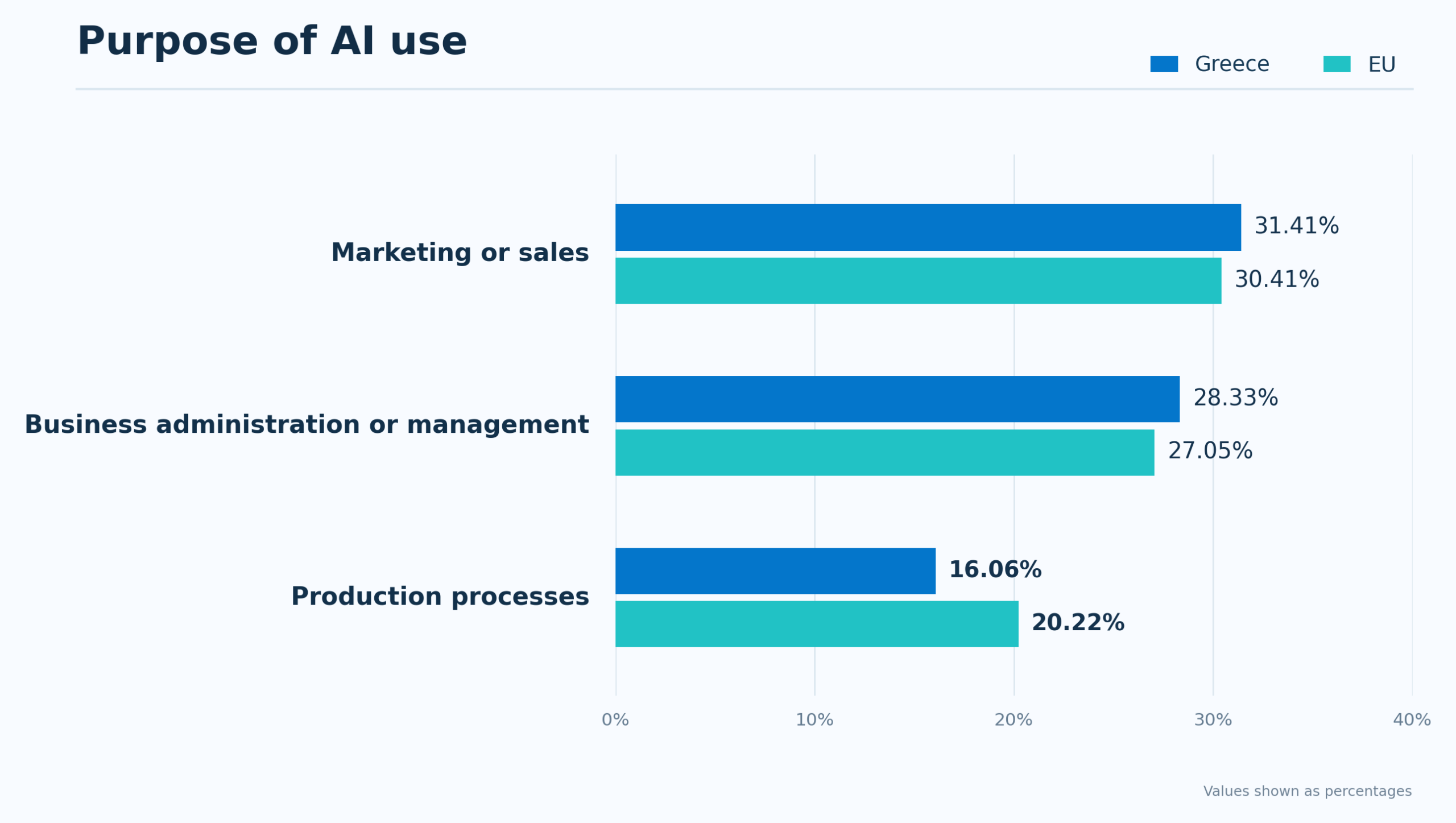
16.06%
of AI-using firms apply AI to production
1.25%
of all Greek manufacturing enterprises
These figures show that marketing and sales, followed by business administration and management, are more frequently reported applications than production processes among AI-adopting Greek manufacturers.
The denominator is critical.
The 16.06% figure does not mean that 16.06% of all Greek manufacturing enterprises use AI for production processes. It refers only to those already using AI.
When expressed against the entire population of Greek manufacturing enterprises covered by the survey, the corresponding share is approximately 1.25%.
This is an important distinction for understanding the current state of industrial AI adoption.
It suggests that reported AI use in production processes remains relatively limited, even among businesses that have already adopted the technology.
However, the figures do not establish whether these applications operate directly on the shop floor, how deeply they are integrated with manufacturing systems, or whether they have delivered measurable productivity improvements. They measure reported purposes of AI use, not operational maturity or business outcomes. Nevertheless, they provide a useful starting point for examining the next stage of digital transformation in Greek manufacturing.
3. Greece’s wider AI readiness challenge: Skills, integration and resources
Other recent research helps explain why moving from initial AI adoption to more advanced applications can be challenging.
The study Unlocking Greece’s AI Potential 2026, conducted by Strand Partners for Amazon Web Services (AWS)
47%
of surveyed Greek businesses have adopted AI (up from 34% in the previous year)
This survey covers a broader business population and uses a different adoption definition and methodology from Eurostat’s harmonized enterprise ICT survey, which covers enterprises with 10 or more persons employed. The figures should not be directly compared.
The AWS study also distinguishes between levels of adoption.
61%
are classified as basic adopters
22%
as intermediate adopters
17%
as transformational adopters.
The distinction reinforces an important point: using AI for routine tasks is different from integrating advanced technologies into core business operations.
The study also identifies significant barriers. Among surveyed manufacturing businesses
55%
cited a shortage of AI skills
48%
reported AI or digital skills gaps
36%
identified limited internal financial resources.
SEV’s Business Pulse 2025 provides additional context.
Among respondents to SEV’s Business Pulse 2025, 25.4% reported having at least some experience or exposure to AI; 18.5% had not started, and 55.1% reported no plans to take AI-related action in the following year.
The survey also records respondents’ concerns about specialised personnel, existing technology infrastructure and data quality or availability.
Taken together, these findings suggest that Greek businesses face challenges extending beyond access to AI tools.
For manufacturers in particular, successful digital transformation requires the ability to connect new technologies with existing production processes, operational systems and workforce capabilities.
From adoption to production
Eurostat’s 2025 figures highlight two important realities for Greek manufacturing.
First, overall AI adoption remains below the European average. Second, among manufacturing enterprises already using AI, production processes are a less frequently reported application than marketing, sales and business administration. The AWS and SEV findings add that skills, infrastructure and data quality are central obstacles, not just access to AI tools.
How can Greek manufacturers move beyond isolated digital applications and build the connected operational foundations needed to make AI valuable in production?
In the second article of this series, we look at what those foundations are, from connected production planning to the role of manufacturing ERP, and the four priorities we believe Greek manufacturers should focus on first.